
Wayne County Court Records After Arrest
Wayne County court records after a jail arrest are maintained by the North Carolina Judicial Branch and the Wayne County Clerk of Superior Court. Wayne County's own public records routing page states that criminal records, civil records, traffic violation records, divorce records, and other court records are maintained by the Clerk of Court rather than Wayne County Government. That split is important. The jail can show custody and booking details, while the court record controls the filed charge, hearing schedule, disposition, judgment, and sentence.
The arrest-to-court path starts with arrest and booking at the Wayne County Detention Center. A magistrate handles the initial appearance and release conditions. District Attorney Matthew Delbridge's District 9 office then prosecutes criminal cases for Wayne, Greene, and Lenoir counties. The DA page states that the office prosecutes criminal cases in District and Superior Courts, prepares the criminal trial docket, represents the State in juvenile proceedings, and advises law enforcement.
Custody and booking details belong with Wayne County jail inmate records. Booking photos and photo limits belong with Wayne County jail roster mugshots. A court record after arrest is the case file that follows the accused person through court, not a promise that an arrest led to conviction.
Search Wayne County Court Records
The North Carolina Judicial Branch provides several court search channels. The Judicial Branch services page links Portal, court record requests, criminal background checks, payments, File & Serve, and bail bondsman lookup. eCourts materials state that Portal supports searches for case information, hearings, records, documents, and payments. The court-record access page also describes public terminals at Clerks' offices, where criminal case information can be searched by defendant name, case number, or victim and witness name.
- Start with the N.C. Judicial Branch Portal or a public terminal at a Clerk of Court office.
- Search by defendant name when no case number is known.
- Use a case number, citation, or hearing search when the jail roster or notice provides one.
- Open the case record and compare each charge to the booking charge, since filed charges can change.
- Check hearing dates, disposition, judgment, and payment status where those fields are public.
- Request copies through the Clerk or Judicial Branch process when the online view does not show the document needed.
The Wayne County Courthouse source page shows the Clerk's Office at the courthouse, with court services and public access details tied to the local court location.
The Wayne County Courthouse source page identifies the courthouse record location used for local case access.
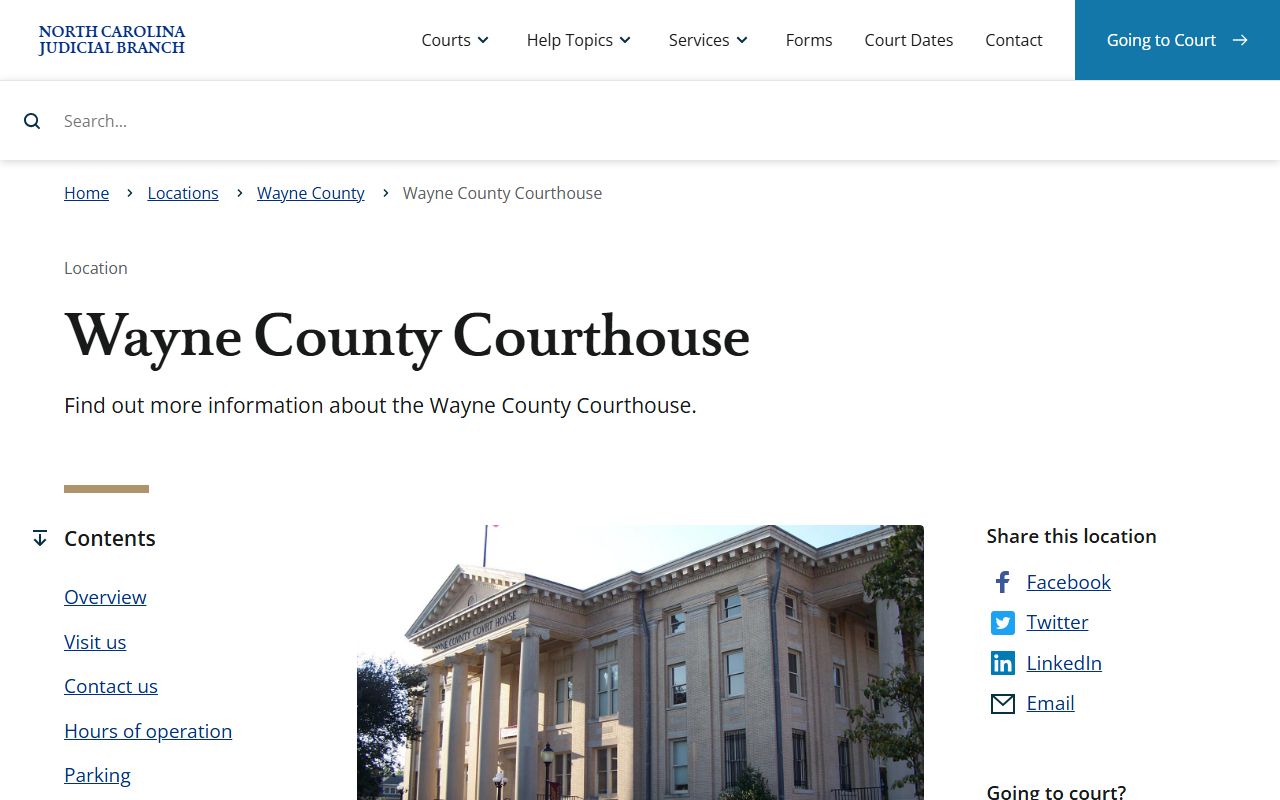
The courthouse record is the public path for case files after the jail booking step has created the first custody record.
Wayne County Case Search Fields
Official Judicial Branch descriptions, not a local scrape of the blocked Portal, supplied the field inventory. The Portal and public terminals may expose different screens, but the searched values are consistent with court case work: names, attorneys, citations, case numbers, hearing criteria, payment tools, and documents when access is allowed.
| Field Label | Type | Required | Notes |
|---|---|---|---|
| Name | Search text | Depends on search | Used for case and hearing searches by defendant or party name. |
| Attorney | Search text | Optional | Official materials say case and hearing searches can use attorney. |
| Citation | Search text | Optional | Common for traffic and citation matters. |
| Case Number | Search text | Optional | Best when a file number or docket number is known. |
| Hearing Criteria | Search text or filter | Optional | Hearings can be searched by name, attorney, case number, and more. |
| Documents / Records | Record view | Access varies | Public records may be viewable, while sealed or sensitive records are restricted. |
| Payment Tools | Online action | Not applicable | The services page says Portal can make payments. |
Charges After a Wayne County Arrest
A booking charge is not always the final filed charge. The Wayne County jail roster can show charge descriptions, offense dates, docket numbers, court dates, disposition fields, sentence length, and crime class. Those fields are useful leads. The District Attorney can amend, reduce, dismiss, or proceed on charges in a different form after review. More serious felony matters can move toward Superior Court through probable-cause or grand-jury processes.
| Document | Who Uses It | How It Fits After Arrest |
|---|---|---|
| Complaint | Officer, magistrate, or prosecutor depending on context | Often starts a criminal matter close to the arrest and booking stage. |
| Information | Prosecutor | Prosecutor-filed charge document used in some criminal case paths. |
| Indictment | Grand jury | Common for felony prosecution in Superior Court after review. |
The DA's public materials explain that District Court usually handles juvenile matters and less serious criminal offenses, while Superior Court handles more serious offenses such as felonies. That distinction helps explain why an arrest may first appear on a jail roster, then later appear under a different court track.
Wayne County Charge Status
Court records after a jail arrest often change as the case moves. A pending case may later be dismissed. A charge may be amended or reduced. A felony can be indicted. A judgment can impose a sentence, and a disposition can appear after plea, trial, or dismissal. Do not treat one jail roster charge row as the complete legal history.
| Status | What It Means |
|---|---|
| Pending | The case or charge remains open and has not reached final disposition. |
| Dismissed | The court or prosecutor ended the charge without conviction. |
| Reduced | The charge changed to a lesser offense during case handling. |
| Amended | The charging language, count, or legal basis changed. |
| Indictment | A grand jury charging document, often tied to felony prosecution. |
| Judgment | Final court order after plea, trial, or other disposition. |
| Expunction | Later court process that can clear eligible public record entries. |
Bond After Wayne County Arrest
Bond and release conditions are set by a judicial official, not by the public website. North Carolina G.S. 15A-534 governs pretrial release conditions. Common release forms include written promise to appear, unsecured bond, custody release, secured bond, and surety bond. Some charges and holds can prevent quick release even when a bond amount appears on one charge.
| Bond Type | How It Works |
|---|---|
| Written promise to appear | Release based on a promise to attend court, with no money posted up front. |
| Unsecured appearance bond | Defendant promises to pay if court is missed, without posting secured money first. |
| Secured bond | Cash, property, or surety backs release before the person leaves custody. |
| Surety bond | A licensed bail agent posts bond and assumes risk for failure to appear. |
| Custody release | Release to a person or organization that agrees to supervise. |
| Hold or no normal bond release | Another case, warrant, probation matter, federal detainer, ICE detainer, or court order blocks release. |
Wayne County roster profiles can show Total Bond Amount and a Booking Bonds table, but the inspected sample did not display bond type. Call the jail at 919-731-1660 to confirm current custody and ask whether a hold exists. For case terms after first appearance, use the Clerk, Portal, or court record.
Warrants and Wayne County Arrest Records
No official Wayne County online active-warrant list was located in the inspected official sources. The Sheriff's Office page confirms an Enforcement Division with a Warrant Unit, but the visible page text did not publish a searchable warrant database. A warrant can still lead to a Wayne County Detention Center booking, and that booking may show a failure-to-appear charge, docket number, offense date, court date, or hold-related clue.
The access chain for warrant-related court records is practical and local: call the Sheriff's Office main line at 919-731-1481 for routing, check current custody with the jail at 919-731-1660 if a booking may have occurred, search court records through Portal or a Clerk public terminal, and contact the Wayne County Magistrates line listed in the court directory at 919-722-6270 for magistrate routing. If a person believes a warrant is active, legal advice is safer than appearing at the jail without understanding arrest risk.
Charges vs Convictions
An arrest charge is an accusation. A conviction is a court outcome after a plea, verdict, or other adjudication of guilt. Wayne County court records after arrest should be read by stage. The jail record may show an early charge and bond. The court record may later show dismissal, amendment, reduction, judgment, sentence, or expunction activity.
| Question | Charge | Conviction |
|---|---|---|
| Stage | Accusation after arrest or prosecutor filing. | Final guilt finding or plea result. |
| Record source | Jail roster may show early charge; court file shows filed charge. | Court judgment and disposition fields control. |
| Can it change? | Yes, it can be amended, reduced, added, or dismissed. | It may later be appealed, modified, or expunged if eligible. |
| How to verify | Search Portal, Clerk terminal, or paper case file. | Verify judgment, disposition, and sentence terms with the court. |
Sealed and Expunged Records
North Carolina public access starts broadly under G.S. 132-1, but court, arrest, jail, and criminal investigation records have exceptions and custodian limits. G.S. 132-1.4 helps explain why some arrest information is public while full investigative files may be restricted. Juvenile, sealed, medical, investigative, internal classification, and expunged records may be withheld or redacted.
| Record State | Public Effect | Wayne County Search Impact |
|---|---|---|
| Sealed | Hidden from general public access by court rule or order. | Portal or Clerk access may show no public document or restricted access. |
| Expunged | Eligible public entries are cleared after a court grants relief. | Use the court order and official custodian process for updates. |
| Dismissed but not expunged | May still appear as a public court entry unless later cleared. | Read disposition carefully before assuming guilt. |
| Investigative material | May be restricted even when arrest facts are public. | Sheriff or court request may produce redactions. |
G.S. 15A-145.5 covers expunction of certain nonviolent misdemeanors and felonies. Expunction is not the same as a casual deletion request. It requires legal eligibility and a court order.
Wayne County Court Contacts
The Wayne County Courthouse is at 224 E. Walnut Street, Room 230, Goldsboro, NC 27530. The Clerk's Office hours are 8:30 a.m. to 5:00 p.m. Monday through Friday, and the courthouse page asks people handling opening new estates, upset bids, or payments to arrive before 4:30 p.m. The main courthouse phone is 919-722-6100.
Wayne County Courthouse
224 E. Walnut Street, Room 230
Goldsboro, NC 27530
919-722-6100
Clerk records, court terminals, case files, and copies.
District Attorney, District 9
P.O. Box 175
Goldsboro, NC 27533
919-722-6200
Prosecutes criminal cases for Wayne, Greene, and Lenoir counties.
Restricted Wayne County Court Records
Not every document tied to a Wayne County arrest is public. North Carolina Chapter 132 provides public-records access, but records can still be limited by juvenile confidentiality, sealed court orders, expunction orders, medical privacy, internal prison and jail classification rules, and criminal investigation limits. Public self-service terminals and Portal may show case information while withholding sensitive documents.
Important: Court records after arrest can show accusations, not convictions. Verify final status with the Clerk or the official case record.